
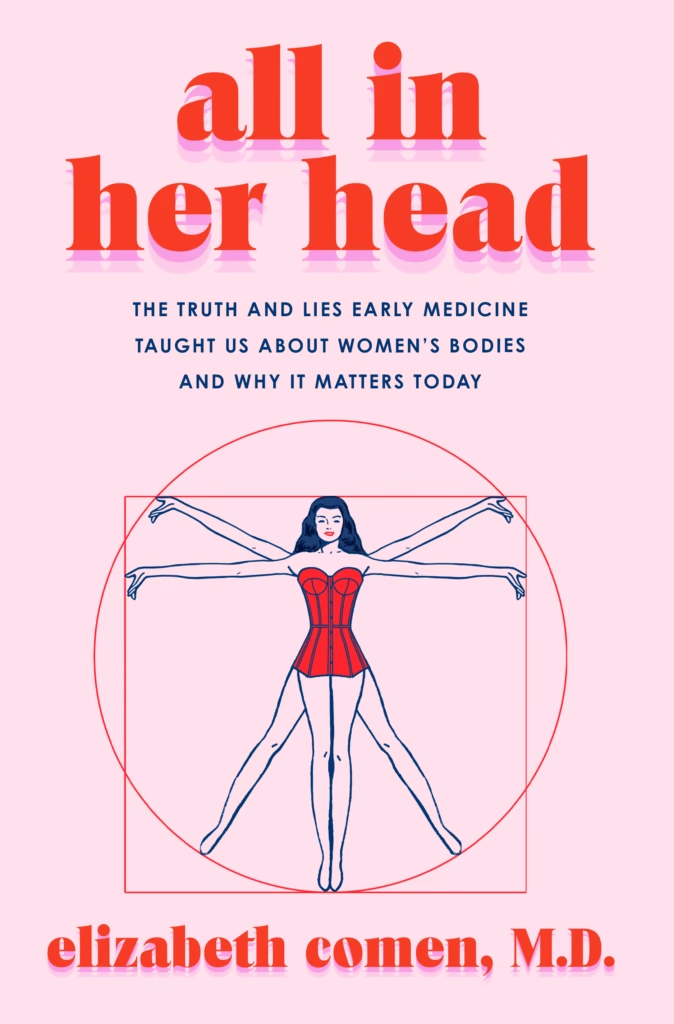
A Therapist’s Review
I should probably begin with a disclosure: I’m a male therapist reviewing a book about how the mental health system has historically misunderstood women. I read this book while on vacation in San Francisco in the morning hours while my family slept. I sat in the lobby of a hotel enjoying good coffee while the city came roaring to life!
Where did we go wrong?
Fortunately, Misty Pratt’s All in Her Head doesn’t require male readers to sit quietly in the corner and contemplate several thousand years of bad decisions—although there are moments when that seems appropriate.
Instead, Pratt asks us to examine how we understand women’s emotional distress, how gender influences mental health treatment, and how often “What is wrong with you?” should probably have been “What happened to you—and what is happening around you?”
This book took me by storm and landed squarely in one of my favorite intellectual neighborhoods: the intersection of mental health, culture, power, biology, and the uncomfortable realization that professionals have not always known nearly as much as we thought we did.
Maybe She Isn’t the Problem
What happens when a client is working full-time, carrying most of the household responsibilities, raising children, caring for aging parents, navigating sexism, managing relationships, experiencing hormonal changes, and somehow still remembering that Thursday is “Crazy Sock Day” at school?
Maybe anxiety isn’t an entirely irrational response.
Side note: See the Fair Play documentary on YouTube.
Pratt challenges us to distinguish between pathology and understandable human distress. There is a profound difference between saying, “Your emotions are symptoms of something wrong with you,” and saying, “Given what you’ve experienced, your emotional response makes sense. Now let’s figure out how to help.”
The latter doesn’t minimize suffering. It contextualizes it.
And context is everything.
Note: Historically, women have disproportionately diagnosed, institutionalized, and subjected to interventions that today would be deemed barbaric. Example – Lobotomy, witch trials, sterlilization under eugenics programs.
The Medical System Has Some Explaining to Do
The historical treatment of women in medicine and psychology is not exactly our profession’s highlight reel.
For generations, women’s pain, sexuality, anger, exhaustion, reproductive experiences, trauma, and emotions have been interpreted through frameworks largely developed by men.
Women have been characterized as hysterical, overly emotional, unstable, hormonal, fragile, dramatic, and—perhaps the most irritating phrase ever uttered in a medical office—“It’s probably just stress.”
Sometimes it is stress. But sometimes something is actually wrong. And sometimes the stress itself is telling us something important.
Pratt explores how gender bias influences diagnosis, medication, research, and the interpretation of symptoms. Women can simultaneously be over-pathologized psychologically and under-recognized medically, which is quite an achievement when you think about it.
Where This Book Connected With Me as a Therapist
The strongest message I took from All in Her Head wasn’t that diagnosis, medication, or therapy are bad. The better question is:
Are we listening carefully enough before deciding what someone’s distress means?
A diagnosis can be incredibly useful, but a diagnosis is a description.
It is not a biography.
“Major depressive disorder” doesn’t tell me about someone’s childhood. “Generalized anxiety disorder” doesn’t explain cultural expectations. “PTSD” might tell me you’ve been hurt but it fails to tell me who failed to protect you, or what you had to do to survive.
Human beings stubbornly refuse to fit neatly into diagnostic checkboxes.
Very inconsiderate of them.
Good therapy requires understanding symptoms while remaining curious about the person experiencing them.
The Feminist Part—From the Guy Reviewing the Book
What interests me about feminism in mental health isn’t arguing that women are always right or men are always wrong.
I’m much more interested in asking:
Who historically had the authority to define what was “normal”?
Who conducted the research? Who wrote the textbooks? Who decided which emotions were appropriate? Whose experiences were considered universal—and whose were considered deviations?
Psychology and medicine don’t exist outside culture.
A feminist-informed approach to therapy asks us to notice power, gender roles, relationships, expectations, autonomy, and social conditions rather than automatically locating every problem somewhere between a client’s ears.
Understanding those forces doesn’t eliminate personal responsibility. It can actually increase agency.
Final Thoughts
Readers shouldn’t leave All in Her Head believing every mental health difficulty experienced by women results from sexism or a broken healthcare system. Human psychology is far more complicated.
Biology matters. Genetics matter. Trauma matters. Relationships matter. Hormones matter. Social conditions matter. Individual choices matter.
Usually several of these things are having a party together, and nobody bothered to invite the therapist.
That’s why I see Pratt’s argument as an important corrective, not a replacement for everything we know about mental health.
Therapists should read this book. Medical professionals should read it. Anyone who has left a healthcare appointment wondering, Did anyone actually hear what I just said? should probably read it.
And men should read it too—perhaps especially men. Not to finish the book feeling guilty for possessing a Y chromosome, but because good books allow us to understand experiences we haven’t personally lived.
All in Her Head ultimately asks us to become more curious about women’s distress rather than simply becoming better at labeling it.
That’s an idea worth carrying into the therapy room.